
Hobby Ag Food Guide
Low PUFA Eggs: What They Are & Why Feed Matters
If you’re searching for lower-PUFA eggs, you’re probably not just looking for “pasture-raised.” You’re looking for eggs from hens raised with a feed program that avoids common high-PUFA ingredients like corn and soy.
Shop Our Corn & Soy-Free EggsWhat are PUFAs?
PUFA stands for polyunsaturated fatty acids. These are naturally occurring fats found in many foods, including eggs. So, to be clear: eggs are not “PUFA-free.” But the amount and balance of fats in an egg can vary depending on how the hens are raised and, especially, what they are fed.
Many people looking for low-PUFA eggs are especially interested in reducing excess omega-6 fats in their diet. That’s where chicken feed becomes important.
The simple version
Chicken feed affects egg fat composition. Hens that eat a steady diet of corn and soy can produce eggs with a different fatty acid profile than hens raised on pasture with a carefully chosen corn- and soy-free ration.
Why chicken feed matters
Unlike cattle, chickens are not ruminants. What they eat can show up more directly in the eggs they lay. That’s why we pay close attention not only to whether our hens are outside on pasture, but also to what goes into their supplemental feed.
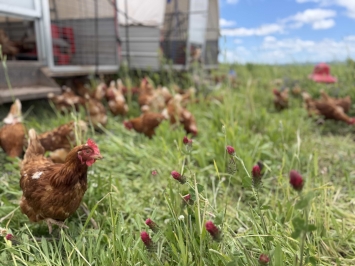
Our hens are raised on regeneratively managed pasture, where they can forage for grasses, bugs, seeds, and other natural food sources. But pasture alone does not provide everything a laying hen needs. A thoughtful feed program is still essential.

Why we avoid corn and soy
Corn and soy are common ingredients in commercial chicken feed because they are affordable, widely available, and calorie-dense. But they are also two ingredients many of our customers are intentionally trying to avoid.
At Hobby Ag, our eggs come from hens fed a corn- and soy-free ration. We believe this better supports the kind of egg many families are looking for: nutrient-dense, pasture-raised, and produced with unusual care.
Our egg standards
- Pasture-raised hens
- Corn-free feed
- Soy-free feed
- GMO-free ration
- Mobile coops on fresh pasture
- No artificial yolk colorants
- No routine antibiotics
Not just “pasture-raised”
Pasture matters. But feed matters too. Many eggs marketed as pasture-raised still come from hens eating corn- and soy-heavy rations. Our approach considers both.
Are pasture-raised eggs always low PUFA?
Not necessarily. “Pasture-raised” tells you something important about how hens live, but it does not tell you the full story about what they eat.
A pasture-raised hen may still receive a supplemental feed based heavily on corn and soy. That’s why someone specifically looking for lower-PUFA eggs should ask about feed, not just outdoor access.
Independent Analysis
What Our Egg Testing Found
We believe exceptional food should be backed by more than marketing claims. That's why we submitted our pasture-raised eggs to the Food Metabolomics Lab at Utah State University for an independent nutritional analysis.
Researchers compared our eggs with several nationally and locally available eggs, evaluating fatty acids, vitamins, minerals, antioxidants, and heavy metals. The goal wasn't to "win" a comparison—it was to better understand the nutritional profile of eggs raised with our farming and feeding practices.
Independent Lab
Tested by the Food Metabolomics Lab at Utah State University.
Lower Total PUFAs
Our eggs measured the lowest total polyunsaturated fat (PUFA) content in the comparison.
Balanced Fatty Acids
Among the lowest omega-6 to omega-3 ratios measured.
Rich Nutrient Profile
High levels of several vitamins while also showing the lowest combined heavy metal concentration.
What stood out
- Lowest total PUFA content among the eggs tested
- One of the lowest omega-6 : omega-3 ratios
- Highest total vitamin concentration when both Hobby Ag samples were considered together
- Lowest combined heavy metal concentration
- Strong antioxidant content compared with other pasture-raised eggs
Important: This was a comparison of a small number of egg sources—not every egg available on the market. We share these results because we believe in transparency and continually learning about the food we produce.
Can eggs be PUFA-free?
No. Eggs naturally contain some polyunsaturated fats. We do not describe our eggs as “PUFA-free.” A more accurate phrase is lower-PUFA eggs or eggs raised with a lower-PUFA feed philosophy.
Who looks for low PUFA eggs?
Many of our customers are families who are trying to be more intentional about the food they bring into their home. Some are avoiding seed oils. Some are looking for corn- and soy-free animal products. Some simply want eggs from a farm they can know and trust.
Whatever brought you here, our goal is the same: to raise food with transparency, care, and respect for the land, the animals, and the people we serve.
Frequently asked questions
Are your eggs PUFA-free?
No. No real egg is PUFA-free. Our eggs are better described as corn- and soy-free pasture-raised eggs for customers seeking a lower-PUFA option.
Are corn-free and soy-free eggs lower in PUFA?
Feed can influence the fatty acid profile of eggs. Avoiding corn and soy is one reason many customers seek out our eggs, especially if they are trying to reduce excess omega-6 intake.
Are your eggs organic?
No—we are not USDA Certified Organic.
Instead of pursuing certification, we've chosen to invest directly in the things we believe matter most: rotational pasture, a corn- and soy-free ration made from non-GMO ingredients and organic feed sources, regenerative land management, and complete transparency about how our hens are raised.
We'd rather show you exactly what we do than ask you to rely solely on a label.
Why does yolk color change?
Yolk color can change with the season, pasture conditions, and forage availability. A darker yolk can be beautiful, but color alone does not tell the whole story about egg quality or nutrition.
What do your hens eat?
Our hens spend their days foraging on fresh pasture for grasses, insects, seeds, and other natural foods. To provide complete nutrition year-round, we also feed a carefully formulated corn- and soy-free ration made from non-GMO ingredients and organic feed sources whenever practical. We avoid artificial colorants and unnecessary additives, focusing instead on simple, high-quality nutrition.
Can I order eggs online?
Yes. You can order our eggs through the Hobby Ag online store for available pickup, delivery, or shipping options depending on your location.

Ready to try better eggs?
Our corn- and soy-free pasture-raised eggs are raised for families looking for something beyond the grocery store shelf.
Shop Eggs